
Affiliate disclosure: FieldOpsLab may earn a commission if you sign up for Housecall Pro or BookingKoala through links on this page. This does not change the price you pay. Our recommendations are based on evidence and buyer fit, not affiliate relationships.
Written by: LPSA
Evidence level: research_based
Product information checked: 2026-08-14
Pricing checked: 2026-09-15
Last meaningfully updated: 2026-09-16
Evidence status
Evidence status: This is a research_based shortlist guide for United States residential cleaning businesses with 6–10 field workers and 1–2 office users. FieldOpsLab reviewed public official pricing pages, public product pages, public help-center documentation, public billing and terms pages, public payment documentation, public import and export documentation, and public integration pages checked on 2026-08-14; Housecall Pro pricing was rechecked on 2026-09-16.
FieldOpsLab did not use a controlled software account, vendor-guided product session, original screenshots, vendor correspondence, or operator interviews for this article. Based on public documentation, this page can support a practical shortlist and a buying framework. It cannot prove live workflow fit, exact final quote, migration quality, export completeness, post-cancellation experience, support quality, or cleaner adoption in practice.
Important: Treat all plan examples below as planning estimates based on public information, not vendor quotes. Pricing, packaging, usage fees, add-ons, payment fees, exports, cancellation terms, and feature access can change.
Workiz dependency refresh: Official pricing was rechecked on 2026-09-15. The current page routes Standard, Pro, and Ultimate through Request pricing and does not state a public included-user allowance or extra-member schedule. This refresh supersedes only Workiz-dependent claims; other source dates remain labeled in the article.
Housecall Pro seat-pricing refresh — 2026-09-16: Official pricing lists Essentials with 5 users and MAX with 8, plus $35/month per additional MAX user. Count all required logins, including office staff. Published rates support planning; confirm cadence, taxes, add-ons, and final contractual terms.
Quick answer
For a residential cleaning business with 6–10 field workers and 1–2 office users, there is still no universal winner. But the buying logic changes meaningfully from the 2–5-person stage.
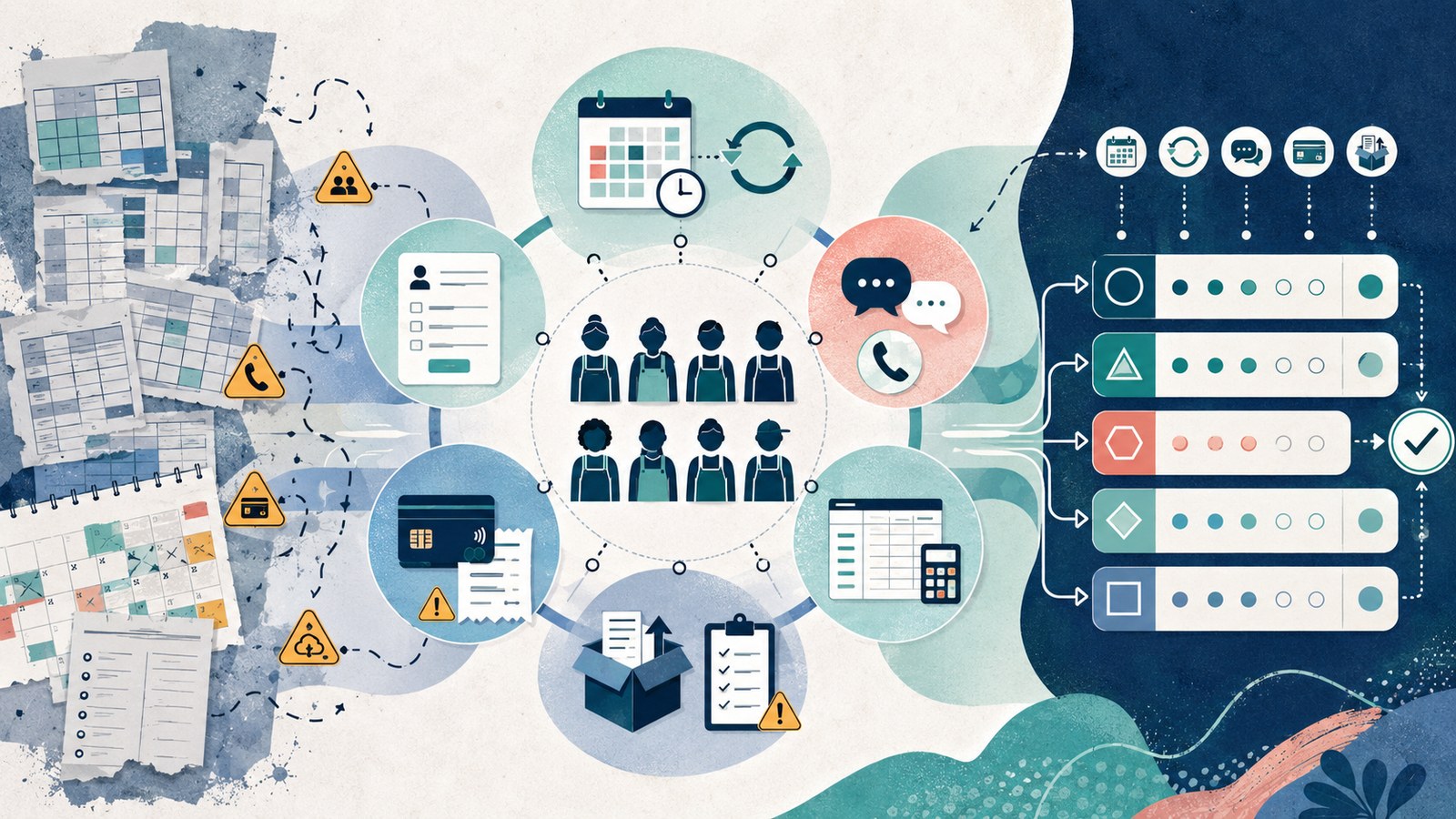
At this point, the real decision is rarely just “which app has scheduling and invoices?” It is usually about seat or provider math, recurring schedule control, cleaner mobile access, customer reminders, payment volume, QuickBooks handoff, online booking, customer self-service, migration risk, cancellation risk, and total cost after short message service (SMS), payment processing, voice, artificial intelligence (AI), onboarding, and hidden fees.
Based on public documentation checked on 2026-08-14, with Housecall Pro pricing rechecked on 2026-09-16, Jobber remains the strongest general field service management (FSM) shortlist when you want relatively legible public user math, recurring visit controls, reminders, online payments, Client Hub, and QuickBooks Online (QBO). Housecall Pro becomes especially relevant when QuickBooks Desktop (QBD), review management, and broader home-service operations matter; its public pricing now gives 6–10 teams a clearer 8-user MAX reference, while 11+ remains sales-led. ZenMaid remains compelling when your operation is still strongly maid-service-centric and you want a cleaning-specific operating model, but public team-size pricing is still less transparent than named-user platforms. BookingKoala is strongest when customer-facing booking flow and self-service are the real bottlenecks. Workiz is most plausible when calls, texts, lead intake, and communication tooling matter enough to tolerate quote-sensitive pricing and add-on complexity.
For pricing context, this guide uses public pricing signals checked on 2026-09-15 and does not include temporary promotional discounts, which may change or expire. For a deeper cost model, see FieldOpsLab’s hidden costs of cleaning business software guide.
If your team is already closer to 11-20 people, use FieldOpsLab’s 11-20-person cleaning software shortlist instead.
Quick verdict
| Product | Best fit for | Why it makes this shortlist | Main caution |
|---|---|---|---|
| Jobber | Broad FSM buyers who want predictable public user math, recurring job support, reminders, payments, and QBO. | Public pricing clearly defines a user, includes 5-, 10-, and 15-user team bands, and documents reminders, checklists, payments, visits, and QBO sync. | Real cost still rises with more logins, payment fees, and higher-tier features such as two-way texting and automations. |
| Housecall Pro | Teams that want broader home-service depth, QBO and QBD, review management, and online booking. | Public pricing is strong enough to model the key 6–10 threshold, and official docs support recurring jobs, online booking, client portal, exports, and QBO/QBD. | The 5-to-6-user jump is expensive, and 11+ user planning still needs written confirmation. |
| ZenMaid | Recurring maid-service operators who care more about cleaning-specific workflow than broad trade-service breadth. | Public pricing, scheduling pages, and mobile app pages point to a cleaning-first workflow. | Visible plan prices stay low, but exact team pricing, export access, and current accounting fit still need verification. |
| BookingKoala | Businesses whose main problem is online booking, customer self-service, and provider scheduling. | Public pricing and features strongly emphasize booking forms, customer accounts, provider accounts, scheduling, and self-service. | Provider counting, Twilio-based SMS, storage/contact limits, and exit risk need very careful review. |
| Workiz | Communication-heavy operations that want calls, texts, AI answering, booking, client portal, and payments inside one stack. | Public pricing materials and communication pages point to stronger phone and lead-management depth than many alternatives. | Public pricing is still incomplete for real team budgeting, and communication add-ons can materially change total cost. |
| Spreadsheets + Google Calendar | A short transition period while you clean data, define roles, and design the migration. | Still useful as a temporary staging layer for customer cleanup, recurring schedule cleanup, and supplier-independent archives. | At 6–10 field workers, this is usually a temporary bridge, not a stable operating system. |
Takeaway: At 6–10 field workers, the strongest shortlist is usually one broad FSM option plus one specialist alternative that matches the real bottleneck, not a fake “best overall” winner.
In this article
- Key facts
- Best for
- Avoid if
- Buyer scenario
- What changes at 6–10 versus 2–5
- Quick comparison table
- Scenario: 6 field workers + 1 office user
- Scenario: 10 field workers + 1 office user
- Optional scenario: 10 field workers + 2 office users
- Shortlist Jobber if…
- Shortlist Housecall Pro if…
- Shortlist ZenMaid if…
- Shortlist BookingKoala if…
- Shortlist Workiz if…
- Stay on spreadsheets temporarily if…
- Pricing and hidden costs
- Recurring scheduling and cleaner mobile workflow
- Payments, accounting, and integrations
- Online booking, customer self-service, and communications
- Export, migration, cancellation, and data risk
- What public evidence cannot verify
- Buyer verification checklist
- Final scenario-based recommendation
- Methodology
- Sources
Key facts
| Item | Research-based takeaway |
|---|---|
| Primary buyer | US residential cleaning business with 6–10 field workers and 1–2 office users. |
| Core buying problem | Choose software that survives seat math, recurring scheduling complexity, cleaner access, reminder volume, payment volume, accounting handoff, online booking pressure, and data-risk questions. |
| Main difference from the 2–5 stage | At 6–10 workers, cost thresholds and workflow breakpoints start to matter more than entry-level plan price. |
| Why no universal winner exists | These products count people differently: Jobber uses named-user bands, Housecall Pro publishes Basic 1, Essentials 5, and MAX 8 user reference points before the 11+ sales-led path, ZenMaid asks for cleaner and office-manager counts, BookingKoala counts providers, and Workiz combines Request pricing with Free User/Pro User role distinctions while included-user and extra-member terms remain unstated. |
| Strongest broad FSM shortlist | Jobber is the most plausible default broad shortlist when public seat math, reminders, QBO, payments, and Client Hub matter. |
| Strongest QuickBooks Desktop shortlist | Housecall Pro stands out because its Essentials plan publicly includes QBO and QBD, and MAX adds extra-user expansion and recurring service plan features. |
| Strongest cleaning-specific shortlist | ZenMaid remains the strongest cleaning-specific option when recurring maid-service workflow matters more than broad FSM breadth. |
| Strongest booking-first shortlist | BookingKoala is strongest when booking forms, customer accounts, and customer self-service create the most value. |
| Strongest communications-forward shortlist | Workiz is strongest when calls, texting, AI answering, and client portal workflows are central to operations. |
| Main buyer risk | Seat/provider thresholds, SMS and phone add-ons, payment fees, export gates, annual commitments, and cancellation rules matter more than the lowest visible subscription. |
Takeaway: At this stage, software stops being just a scheduling decision and becomes an operating-model decision.
Best for
- US residential cleaning businesses with 6–10 field workers and 1–2 office users.
- Companies running recurring and one-time residential jobs.
- Teams replacing spreadsheets, Google Calendar, texting, manual invoices, and patchwork tools.
- Buyers who want a shortlist built around real operating models instead of a generic SaaS roundup.
- Owners who need to see where the 6-to-10-worker stage changes the recommendation compared with the 2–5-person guide.
Avoid if
- You want a single universal winner.
- You want a controlled-account product verdict instead of a research-based shortlist.
- You need a guaranteed total monthly number without vendor confirmation.
- You plan to treat unknown costs as zero.
- You are not ready to define who needs logins, who needs mobile access, and how recurring scheduling actually works in your business.
Buyer scenario
The target buyer is a US residential cleaning company with recurring and one-time home-cleaning work, 6–10 field workers, and 1–2 office users. The current workflow may still include spreadsheets, Google Calendar, texting, manual invoices, disconnected payments, and inconsistent reminder workflows. The company is no longer choosing a first basic tool. It is usually replacing a fragile operating stack.
For adjacent workflow decisions, compare this shortlist with FieldOpsLab’s time tracking and team assignment guide and estimating and quote software guide.
FieldOpsLab models three planning scenarios in this article:
| Scenario | Field workers | Office users | Why it matters |
|---|---|---|---|
| Core scenario | 6 | 1 | First clear point where low-end plans break and every cleaner may need mobile access. |
| Larger core scenario | 10 | 1 | Tests whether a platform still fits when reminder volume, payments, and recurring changes become heavier. |
| Optional stress test | 10 | 2 | Shows whether a second office login changes plan bands, permissions, accounting handoff, and communication workload. |
Takeaway: Count both the cleaners and the office staff. At this stage, “we only have one dispatcher” does not mean you have a low-cost software setup.
What changes at 6–10 versus 2–5
Compared with the 2–5-person stage, the 6–10 stage changes the buying decision in six practical ways.
First, seat math starts to dominate. At 2–5 people, one extra login can sting. At 6–10 field workers, the entire pricing band can change. Jobber moves from 5-user to 10-user public team packages on its pricing page. Housecall Pro publishes Essentials for 5 users and MAX for up to 8 users on its pricing page; 6–8 users can use MAX as the planning reference, while MAX lists $35/month per additional user above its 8 included users; use that as the incremental planning allowance for 9–10 total logins, then confirm billing cadence, taxes, add-ons, and final terms. BookingKoala can force a shift from Starter to Growing as soon as you go above 5 providers. Workiz becomes harder to budget because the public page uses Request pricing and does not state included-user or extra-member terms.
Second, recurring scheduling complexity matters more than feature checklists. With more cleaners and more recurring households, the problem becomes skipped visits, one-off changes, cleaner reassignment, rescheduling, and future-series control. Official help docs for Jobber Visits, Housecall Pro recurring jobs, and BookingKoala frequencies are much more important at this stage than homepage feature lists.
Third, cleaner mobile adoption becomes a system requirement. At 2–5, some teams can still centralize work through one office login and shared messages. At 6–10, that usually breaks down. Cleaner-facing schedule access, notes, checklists, “on my way” updates, and job completion handling become operational requirements. That favors tools with stronger public mobile and field documentation, such as ZenMaid’s cleaner app, BookingKoala’s provider app, Jobber visits, and Workiz’s mobile-heavy positioning on its pricing page.
Fourth, payment and reminder volume stop being small extras. More recurring clients means more card volume, more reminder messages, more reschedule notices, and more follow-up activity. That is why payment rates, SMS rules, and communications add-ons matter more than they did for smaller teams. Jobber publicly lists 2.9% + 30¢ card processing and 1% ACH. Housecall Pro says card processing fees start at 2.59% and bank payments cost 1%. BookingKoala routes SMS through Twilio. Workiz sells communication tools separately on its pricing page.
Fifth, migration and export risk become more expensive. The larger the active customer list and recurring schedule base, the less safe it is to buy first and ask about exports later. Public docs already show meaningful differences between Jobber client export, Housecall Pro customer and job export, ZenMaid Pro Max export access, and BookingKoala account deletion language.
Sixth, written vendor confirmation becomes more important. At 2–5 people, a team can sometimes tolerate a little ambiguity and fix workflow later. At 6–10, that ambiguity can become expensive. Ask for written confirmation before purchase on seats, providers, logins, message pricing, payment rails, migration support, exports, and downgrade or cancellation rules.
Quick comparison table
| Product | Operating model | 6+1 fit | 10+1 fit | Main pricing threshold | Recurring fit | Cleaner mobile fit | Payments/accounting fit | Booking/self-service fit | Best-fit scenario | Avoid-if scenario |
|---|---|---|---|---|---|---|---|---|---|---|
| Jobber | Broad FSM with named users | Strong | Strong | 5-user to 10-user to 15-user public bands | Strong public visit controls | Good | Good for QBO; public payment rates available | Good, especially with Client Hub | You want broad operations software with public user math | You need QBD or deep communication tooling first |
| Housecall Pro | Broad home-service FSM with plan bands | Strong | Strong but cost-sensitive | MAX includes 8 users; published extra-user reference is $35/month each; confirm final terms | Strong public recurring controls | Good | Strong for QBO and QBD | Good online booking and client portal | You want broad home-service depth and QBD | You want the lowest-friction pricing jump at 6 users |
| ZenMaid | Cleaning-specific workflow with cleaner/office math | Strong shortlist | Plausible, but verify first | Visible list price is not full team quote | Strong cleaning-specific positioning | Strong public mobile signals | Stripe/Square yes; QBO/QBD still weak publicly | Good booking-form signals | You mainly run recurring maid service | You need clear named-user pricing or live QBO/QBD confidence today |
| BookingKoala | Booking-first platform with provider counting | Plausible | Plausible | 5-provider Starter cap; 15-provider Growing cap | Strong booking-form recurrence controls | Good provider app signals | Good payment options; accounting fit less clear publicly | Strongest self-service profile here | Online booking and customer self-service are the bottleneck | You want simple named-user math and easy exit assumptions |
| Workiz | Communications-forward broad FSM | Plausible if communication-heavy | Plausible but quote-sensitive | Included-user math plus extra users and sold-separately communication tools | Public recurring support exists, but cleaning edge cases still need validation | Good public mobile and field signals | Strong public payments/QBO/QBD signals, but quote-sensitive | Strong client portal and online booking | Calls, texts, AI, and lead handling matter as much as scheduling | You need transparent public total pricing before talking to sales |
| Spreadsheets + Google Calendar | Manual transition baseline | Weak for ongoing use | Poor for ongoing use | Low software cost, high labor cost | Weak under recurring exceptions | Weak | Manual | Weak | You are cleaning data before migration | You need scalable recurring scheduling and payment automation now |
Takeaway: Jobber and Housecall Pro are the safest broad shortlists. ZenMaid is the strongest cleaning-specific counterweight. BookingKoala and Workiz become especially interesting when booking flow or communications, not just scheduling, drive the purchase.
Scenario: 6 field workers + 1 office user
This scenario means 7 total employees. The conservative planning assumption is that every cleaner and the office user need access. Whether that means seven licensed users, seven providers, or some mix of paid and limited users depends on the platform.
| Product | Likely plan path or pricing model | Main cost risk | Main workflow risk | Buyer action | Confidence |
|---|---|---|---|---|---|
| Jobber | Most plausible public path: Connect for up to 10 users or Grow for up to 10 users depending feature needs on Jobber pricing. | Choosing Grow when Connect is enough, or underestimating payment fees and any extra add-ons. | Deciding whether two-way texting and custom automations are really needed now. | Shortlist early if public user math, reminders, QBO, and Client Hub matter. | High |
| Housecall Pro | For 6–8 total users, MAX includes all required logins. For 9–10 total users, budget the MAX base plus $35/month for each user above 8 (an extra $35 or $70/month), subject to confirmation of cadence, taxes, add-ons, and final terms on Housecall Pro pricing. | The published 8-user allowance and $35/month additional-user rate support a planning estimate; final commercial terms and add-ons still require written confirmation. | Whether your recurring cleaning workflow fits Housecall Pro’s broader home-service model well enough to justify the price jump. | Shortlist if QBD, reviews, and home-service breadth are important enough to justify MAX. | Low to medium until quoted |
| ZenMaid | Most plausible visible floor: Pro or Pro Max on ZenMaid pricing, but exact team quote is not public. | Assuming the visible $39–$49 plan price is the real team cost. | Whether current accounting and export needs fit the product at this stage. | Shortlist if recurring maid-service workflow is the priority and you are willing to get written team pricing. | Medium |
| BookingKoala | Most plausible path: Growing from $57/month because 6 cleaners exceed the Starter 5-provider cap on BookingKoala pricing. | Twilio, payment processing, provider counting, office-user ambiguity, and future provider churn. | Whether booking-first logic is really the central problem rather than wider operations management. | Shortlist if online booking and self-service are the main growth bottlenecks. | Medium |
| Workiz | Most plausible path: Standard or Pro with the user allowance and extra-member terms confirmed in writing, because public base totals still need a quote on Workiz pricing. | Base pricing, extra Pro Users, communication add-ons, and Workiz Pay economics. | Assuming Workiz communication depth outweighs its budget complexity. | Consider if the office depends heavily on calls, lead handling, texts, and portal workflows. | Low to medium |
| Spreadsheets + Google Calendar | No subscription threshold, but labor time becomes the real cost. | Owner and office time, missed reminders, missed payments, and messy data. | Recurring exceptions and mobile coordination usually break down here. | Use only as a short transition while cleaning data and planning migration. | High |
Takeaway: For 6+1, Jobber and Housecall Pro become the clearest broad shortlists. ZenMaid becomes attractive if you still want a cleaning-specific operating model. BookingKoala and Workiz make more sense only when booking flow or communications justify the extra complexity.
Scenario: 10 field workers + 1 office user
This scenario means 11 total employees. At this point, cleaner mobile access, office permissions, reminder volume, and accounting handoff pressure are no longer edge cases. They are standard operating requirements.
| Product | Likely plan path or pricing model | Main cost risk | Main workflow risk | Buyer action | Confidence |
|---|---|---|---|---|---|
| Jobber | Most plausible public path: Connect up to 15 users or Grow up to 15 users on Jobber pricing. | The jump from the 10-user band to the 15-user band can make annual commitments look tempting before you verify workflow. | Whether Connect is still enough or Grow’s two-way texting, job costing, and automations have become worthwhile. | Still one of the safest broad shortlists because the public math remains comparatively clear. | High |
| Housecall Pro | The public page publishes MAX for up to 8 users and routes larger teams toward a configuration flow. For this 11-user scenario, request a tailored quote. | Included users, additional-user charges, and final 11-user plan cost require written confirmation. | Whether broader FSM depth is worth the higher user expansion cost. | Shortlist if QBD, review management, and a broader home-service operating model still matter enough to justify the spend. | Low until quoted |
| ZenMaid | Most plausible visible floor: Pro Max if you want data export, branded booking forms, and more room for office complexity, but exact team pricing still is not public. | Assuming team size will not affect the real commercial quote because visible list price is low. | Accounting depth and large-team administrative workflow still need direct confirmation. | Still shortlist-worthy if your operation remains strongly recurring-cleaning-centric. | Medium |
| BookingKoala | Most plausible path: Growing from $57/month still covers 10 providers, but provider churn, deactivated providers, and advanced workflow needs can push you upward. | Provider caps are less of a problem at 10 than at 16, but Twilio, storage, and customer/account-management complexity still matter. | Whether the platform’s booking-first design is still the right answer once office workflow pressure increases. | Shortlist if customer-facing booking, self-service, and provider scheduling remain the core bottleneck. | Medium |
| Workiz | Most plausible path: a Standard or Pro quote, or a move toward Ultimate if operations are becoming more complex. The user allowance, role mix, and public total still require a written quote. | Seat cost, communication packages, AI, VoIP, and payment features can stack quickly. | Whether communication depth really offsets quote-sensitive pricing and role uncertainty. | Best considered when the office runs on calls, texts, lead follow-up, and portal-driven service. | Low to medium |
| Spreadsheets + Google Calendar | Operationally weak at this point. | High labor cost, high failure risk, poor audit trail. | Recurring edits, reminders, and payment follow-up become too fragile. | Usually not acceptable except during a tightly managed migration window. | High |
Takeaway: For 10+1, broad FSM tools usually win more often unless your real bottleneck is either cleaning-specific recurring workflow or booking-first customer self-service.
Optional scenario: 10 field workers + 2 office users
This scenario means 12 total employees. The second office login does not usually change the strategic recommendation by itself, but it can change cost bands, permissions, and accounting handoff pressure.
| Product | What changes when a second office user appears | Practical effect |
|---|---|---|
| Jobber | Still likely within the 15-user band on public pricing. | The second office user is more about permissions and workflow than a new pricing cliff. |
| Housecall Pro | Requires a revised written configuration because the second office user changes the licensed-user count. | The second office login strengthens the case for written pricing and role confirmation. |
| ZenMaid | Public calculator already asks for both cleaners and office managers. | This is exactly where visible list price becomes too thin to trust without a written quote. |
| BookingKoala | Provider count may not change if only office staffing changes, but account-role and office-workflow questions do. | The problem becomes operational clarity, not just provider caps. |
| Workiz | One more Pro User may matter if that office person needs scheduling, dispatch, invoicing, or communication permissions. | Role design matters even more because Free User and Pro User differences become cost-relevant. |
Takeaway: A second office user usually increases the importance of permissions, reporting, communications, and bookkeeping accuracy more than it changes the category recommendation itself.
Shortlist Jobber if…
Shortlist Jobber if you want the most straightforward public seat math among the broad FSM options in this article. Jobber’s pricing page clearly defines a user as anyone who accesses the account in the office or in the field and publishes 5-, 10-, and 15-user bands, while teams at 16+ users are directed to sales. Its public feature set also supports reminders, checklists, visits, online booking, Client Hub, and QBO sync.
Jobber is not the strongest fit if you specifically need QBD or the most communication-heavy stack. It is strongest when you want a broad operations platform with fewer pricing mysteries than Workiz or provider-count logic like BookingKoala.
Verify first how many cleaners really need individual logins, whether Connect is still enough at your stage, and whether Grow’s two-way texting and custom automations are worth the higher plan path. For pricing detail, see our Jobber pricing guide.
Shortlist Housecall Pro if…
Shortlist Housecall Pro if QBD matters, if online booking and review management matter, or if you want a broader home-service operating system. Public pricing gives a published MAX reference for up to 8 users; 6–8 teams can plan around MAX, while 9–10 total-user teams can use the published $35/month per additional user as a planning allowance and confirm final configuration and add-ons. The 11+ path remains sales-led.
Housecall Pro is especially relevant when a residential cleaning business wants the deeper accounting and review-management story that some smaller alternatives do not offer publicly. Its help docs also clearly show recurring-job editing for a single job versus future jobs in the series.
It is not the most comfortable fit if you are highly price-sensitive and need a fully public 11+ user total, or if QBD does not matter to you. For pricing detail, see our Housecall Pro pricing guide.
Before shortlisting Housecall Pro: confirm the exact plan, included users, additional-user charges, add-ons, payment-processing fees, onboarding, migration, cancellation terms, and export access for your 6–10 person team.
If Housecall Pro still looks like a fit after written pricing confirmation, explore Housecall Pro’s current offer.
Shortlist ZenMaid if…
Shortlist ZenMaid if you mainly run recurring residential cleaning and still want a cleaning-specific operating model rather than a general trade-service platform. Public ZenMaid materials strongly emphasize scheduling, cleaner notes, booking forms, cleaner mobile access, recurring appointments, and appointment-tied invoicing.
ZenMaid stays attractive at 6–10 field workers because it still looks purpose-built for maid-service workflow. But the buying caution is real: the visible list prices are low, the pricing page asks for cleaner and office-manager counts, SMS is excluded from the plan price, export appears on Pro Max, and QBO is still labeled “coming soon” on the pricing page checked on 2026-08-14.
ZenMaid is not the strongest fit if you need fully transparent user-based pricing or strong public QBO/QBD confidence today. For pricing detail, see our ZenMaid pricing guide.
Shortlist BookingKoala if…
Shortlist BookingKoala if the real bottleneck is online booking, customer self-service, customer dashboards, booking forms, and provider scheduling. Public features and help docs show especially strong customer-account and provider-account depth, and the platform’s booking-first logic is unusually clear in its public documentation.
BookingKoala becomes more interesting as a 6–10-person cleaning shortlist when your website intake and self-service layer are holding growth back more than dispatch or accounting. It also becomes more risky because the pricing model depends on providers, not just named office users, and because each team member counts as a provider.
It is not the best fit if you want simple named-user pricing, uncomplicated exit risk, or a broad FSM replacement by default. For pricing detail, see our BookingKoala pricing guide.
Before shortlisting BookingKoala for a 6-10 person team: verify provider counts, office-user assumptions, Twilio/SMS spend, storage/contact limits, payment fees, export access, and cancellation/data-retention terms in writing.
If BookingKoala’s booking-first workflow still looks like the right fit, request a BookingKoala demo.
Shortlist Workiz if…
Shortlist Workiz if your business is communication-heavy: lots of calls, texts, lead intake, booking, and office-driven follow-up. Public Workiz materials emphasize built-in phone, two-way texting, AI answering, online booking, client portal, online payments, and QuickBooks integration more aggressively than many other tools in this comparison.
Workiz becomes more plausible at 6–10 field workers when the owner is not just buying a scheduler, but a communication and intake system. That can matter a lot for cleaning companies that win work through missed calls, text follow-up, and customer-service speed.
It is not the best shortlist if you need transparent public total pricing or if your primary need is the cleanest possible recurring maid-service workflow rather than a broader communication stack. For pricing detail, see our Workiz pricing guide.
Stay on spreadsheets temporarily if…
Staying on spreadsheets and Google Calendar can still make sense temporarily if you are in the middle of data cleanup, you have not defined who needs logins, your recurring schedule data is messy, or you are not ready to sign an annual commitment yet.
But for ongoing operations, the spreadsheet path is much weaker at 6–10 field workers than it was at 2–5. Once cleaner reassignment, reminders, payment collection, office coverage, and customer self-service become real issues, manual tools stop being cheap. They become expensive in owner attention.
Pricing and hidden costs
The sticker price is not the real price for a 6–10-person cleaning team. The real cost is usually base plan + seat/provider math + SMS or phone spend + payment fees + onboarding/migration + accounting cleanup + annual contract risk. For a deeper framework, see our hidden-cost guide.
| Product | Subscription model | Message/phone cost risk | Payment cost signal | Plan-gate risk | Exit-risk signal |
|---|---|---|---|---|---|
| Jobber | Clear named-user pricing bands on official pricing | Two-way texting appears on Grow | Publicly lists 2.9% + 30¢ cards and 1% ACH | Connect vs Grow matters more as complexity rises | Client export is on select plans and plan changes happen at billing boundaries |
| Housecall Pro | Plan bands plus MAX add-on users | Less transparent usage math than pure payment pricing | Publicly says bank payments are 1% and card fees start at 2.59% | 6 users often means MAX | Export docs are clear for customers and jobs, but total exit experience still needs confirmation |
| ZenMaid | Low visible list price, but team math still needs confirmation | SMS not included | Uses Stripe and Square with no ZenMaid fee on top | Starter 40-appointment cap; export on Pro Max | Terms say downgrading may cause loss of content, features, or capacity |
| BookingKoala | Provider-count and storage/contact-driven model | SMS uses Twilio | Processor fees depend on selected processor | Starter 5 providers, Growing 15, Premium 50+ | Cancel-account help doc says deleted accounts cannot be restored |
| Workiz | Partly public, still quote-sensitive | Communication tools sold separately; AI answering requires phone plan | Public payment methods are broad, but fee math is not fully exposed | Standard/Pro/Ultimate plus any quoted users and add-ons | Terms include annual auto-renewal, non-refundable fees, and data-backup responsibility |
Takeaway: The wrong software is often not the one with the highest sticker price. It is the one whose real pricing unit was misunderstood.
Recurring scheduling and cleaner mobile workflow
Recurring scheduling quality matters more at 6–10 field workers than it did at 2–5. Official docs show meaningful differences.
Jobber separates jobs from visits. Its Visits help article explains that recurring jobs create repeating visits, that individual visits can be edited separately, and that rescheduling a visit only affects that visit. That is a strong public signal for recurring-change control.
Housecall Pro documents both single-job changes and whole-series changes. The same article explains “Only this job,” “This job and all future jobs,” and “This and Future Occurrences” deletion behavior. Publicly, that is one of the clearest recurring-edit models in this group.
ZenMaid remains strong on public cleaning-specific workflow language, with scheduling, cleaner mobile detail, “On my way” messaging, job completion, client details, notes, and checklists all heavily emphasized across its scheduling page and mobile app page. But public evidence still does not fully prove every recurring exception flow in practice.
BookingKoala documents frequency logic in detail. Its frequency setup article says the system holds future recurring space automatically and supports configurable recurring frequencies, provider exclusions by frequency, recurring discounts, and one-time versus recurring options. The customer dashboard docs also show customer-side edit, reschedule, cancel, and resume behavior when allowed.
Workiz publicly lists recurring jobs, mobile application, checklists, and client portal capabilities on its pricing page. But its public materials speak more clearly about broad field workflow than about recurring residential-cleaning edge cases such as skipped biweekly cleans, paused customers, or one-off holiday moves.
For cleaner mobile workflow, ZenMaid and BookingKoala read as especially cleaning-native in public documentation. Jobber and Housecall Pro read as strong general FSM tools. Workiz reads as strong for field communications and operational updates. The right choice depends on whether your pain is job execution, recurring control, or customer communication.
Payments, accounting, and integrations
The payments and accounting layer gets more important at 6–10 workers because invoice volume, saved-card usage, and bookkeeping cleanup all start to compound.
Jobber publicly lists credit card processing at 2.9% + 30¢ and bank payments at 1%, and its pricing page says Connect and above sync with QBO. Public pricing does not offer QBD.
Housecall Pro publicly says card processing starts at 2.59% and bank payments cost 1%. Its Essentials plan publicly includes both QBO and QBD. That makes it one of the strongest accounting shortlists in this article when QBD still matters.
ZenMaid says on its credit card processing page that it uses Stripe and Square and adds no ZenMaid fee on top. Its pricing page still labels QuickBooks integration as “coming soon,” so public accounting confidence remains weaker than the broad FSM tools.
BookingKoala supports Stripe, Square, PayPal via Braintree, and Authorize.net, but only one payment processor at a time. The same official help article says BookingKoala itself does not add payment-processing fees on top of the processor, but the processor determines the actual fees. Public accounting-integration depth is less obvious than its booking and payment features.
Workiz has a stronger public payments-plus-accounting story than many buyers may expect. Its online payments page says customers can pay with cards, digital wallets, ACH, and consumer financing. Its QuickBooks integration page says it works with QBO and QBD and syncs invoices, Workiz Pay payments, customer information, and related transaction data. That is attractive, but final processing economics still need written confirmation.
If your bookkeeper cares more about QBD support than about booking forms, Housecall Pro and Workiz deserve extra attention. If you care more about easy public pricing plus QBO than about QBD, Jobber remains easier to model.
Online booking, customer self-service, and communications
This is the section where the shortlist starts to diverge most clearly.
Jobber offers Client Hub and online booking, and its public pricing page says clients can approve quotes, check appointment details, and pay invoices there. For many cleaning companies, that is enough.
Housecall Pro puts online booking, review management, reminders, and client portal features directly on the pricing page. It is strong if you want a classic home-service customer experience layer.
ZenMaid emphasizes booking forms, recurrence-friendly scheduling, and cleaner-friendly mobile workflow. Its booking software page positions embedded booking forms as a 24/7 conversion layer for cleaning companies.
BookingKoala is the strongest pure self-service story in this comparison. The official features page and customer dashboard help article show booking, rebooking, edit/reschedule, cancel/resume behavior, gift cards, referral systems, ratings, tips, and customer dashboards. If you want the customer to do more of the work, BookingKoala becomes very credible.
Workiz is strongest where customer communication overlaps with office communication. Its Client Portal page says customers can view past and upcoming services, approve estimates, pay invoices and deposits, and manage bookings. Its communication page and pricing materials also emphasize an integrated phone system, two-way texting, ad tracking, call flows, and AI answering.
If your sales problem is “customers should be able to book, change, and manage more on their own,” BookingKoala moves up. If your office problem is “we need to answer, text, and convert more leads faster,” Workiz moves up.
Export, migration, cancellation, and data risk
At 6–10 field workers, migration and exit risk should be part of the purchase decision, not an afterthought. See also our migration checklist.
Jobber publicly documents client export to CSV or vCard, but says exporting is available on select plans. That does not prove full object-level export for every data type, so confirm before purchase.
Housecall Pro publicly documents customer and job import/export, including CSV exports of both lists. That is a strong public export signal, though not complete proof of every object you may care about.
ZenMaid places data export on Pro Max, and its Terms of Service say downgrading may cause loss of content, features, or capacity. That means export and downgrade questions should be written into your buying process.
BookingKoala is one of the strongest warnings in this section. Its cancel-account help article says canceled accounts are deleted and stored data cannot be retrieved. Its downgrade help article also says provider thresholds count both active and deactivated providers. That is exactly the kind of small print that matters for a growing cleaning company.
Workiz also deserves careful review. Its Terms and Conditions say the default term is 12 months, terms auto-renew unless notice is given, fees are non-refundable, downside flexibility is limited on annual billing, and the customer is responsible for downloading or backing up its content before termination. Those are not disqualifiers, but they do raise the bar for written confirmation.
At this stage, the safest buyer habit is simple: request sample exports, document the recurring-data plan, and do not cancel the old system until the new one is working.
What public evidence cannot verify
- The exact final quote for your 6+1, 10+1, or 10+2 team.
- Real monthly spend after SMS, phone, AI, taxes, payment fees, and add-ons.
- How well your cleaners will adopt each mobile workflow.
- The exact recurring-cleaning edge-case behavior for your business rules.
- Migration effort and data cleanup time.
- Full export completeness for every data object you care about.
- Support quality and response quality after purchase.
- The practical cancellation experience after a long real-world deployment.
- Whether a limited user, free user, provider account, or staff role is enough for your exact cleaner workflow.
Buyer verification checklist
- Get a written quote for 6 field workers + 1 office user.
- Get a written quote for 10 field workers + 1 office user.
- If relevant, get a written quote for 10 field workers + 2 office users.
- List exactly who needs a login and who only needs limited access.
- Confirm whether each cleaner needs full mobile access.
- Ask the vendor to show recurring setup, one-off changes, future-series changes, and skipped visits.
- Confirm crew, pair, or team assignment logic.
- Confirm reminder rules, SMS pricing, and any phone or AI add-ons.
- Confirm card-on-file behavior, ACH options, and real payment-processing fees.
- Confirm QBO or QBD behavior in writing with your bookkeeper’s needs in mind.
- Ask for customer, job, recurring, and provider export examples before purchase.
- Ask what happens after downgrade, cancellation, or non-renewal.
- Ask whether annual billing changes downgrade rights or refund rights.
- Keep a spreadsheet backup and migration map before turning off the old system.
- Use our demo questions, our recurring scheduling guide, and our migration checklist before signing.
Before you book demos: Turn this 6–10-person shortlist into a written vendor-confirmation script with FieldOpsLab’s cleaning software demo questions. Pair it with the cleaning software migration checklist before you migrate data, sign an annual term, or cancel the old system.
Final scenario-based recommendation
For most US residential cleaning companies with 6 field workers + 1 office user, Jobber is the strongest default broad shortlist when public seat math, reminders, payments, Client Hub, and QBO matter. Housecall Pro belongs on the shortlist when QBD, reviews, and broader home-service depth matter enough to justify the move into MAX. ZenMaid becomes the most plausible specialist shortlist when the business still thinks like a recurring maid-service company first and wants a cleaning-specific operating model.
For 10 field workers + 1 office user, broad FSM tools usually become more attractive because the office and accounting pressure increase. That tends to strengthen the case for Jobber and Housecall Pro, while keeping ZenMaid viable when the workflow is still deeply recurring-cleaning-centric. BookingKoala remains attractive mainly when online booking and customer self-service are the real growth levers. Workiz remains attractive mainly when communication flow and lead intake drive the purchase more than pure scheduling.
If you want the shortest practical buying rule, use this:
- Shortlist Jobber when you want broad capability with comparatively predictable public seat math.
- Shortlist Housecall Pro when QBD and broader home-service depth matter enough to justify higher seat pressure.
- Shortlist ZenMaid when you want a cleaning-specific operating model more than a broad trade-service platform.
- Shortlist BookingKoala when your booking flow and customer self-service layer are the bottleneck.
- Shortlist Workiz when calls, texts, and AI-assisted communication matter as much as dispatch.
- Stay on spreadsheets only temporarily if you are still cleaning data and defining the migration.
Methodology
This article was built from public official vendor sources checked on 2026-08-14, including pricing pages, feature pages, help-center documentation, billing and terms pages, payment documentation, import/export documentation, and integration pages for Jobber, Housecall Pro, ZenMaid, BookingKoala, and Workiz.
FieldOpsLab also used its internal research context from the broader cleaning software guide, the 2–5-person shortlist guide, vendor pricing analyses, the hidden-cost guide, the recurring scheduling guide, the migration checklist, and the demo-question framework to shape the scenarios and buyer diligence logic for this article.
This article is scenario-based editorial analysis for a specific buyer profile. It is not a product test, a product demo transcript, or a final vendor quote.
Sources
- Jobber pricing
- Jobber Client Hub
- Jobber Help Center: Visits
- Jobber Help Center: Export Client Information
- Housecall Pro pricing
- Housecall Pro Help Center: Manage Recurring Jobs
- Housecall Pro Help Center: Import & Export Jobs and Customers
- ZenMaid pricing
- ZenMaid Terms of Service
- ZenMaid credit card processing
- ZenMaid mobile app
- ZenMaid scheduling software
- ZenMaid booking software
- BookingKoala pricing
- BookingKoala features
- BookingKoala Help Center: Setting up frequencies for every form
- BookingKoala Help Center: Customer dashboard explained
- BookingKoala Help Center: Provider app overview
- BookingKoala Help Center: Set up Twilio
- BookingKoala Help Center: Payment processors overview
- BookingKoala Help Center: Upgrade or downgrade your subscription
- BookingKoala Help Center: Close/cancel your account
- Workiz pricing & plans
- Workiz Communication Suite
- Workiz online payments
- Workiz Client Portal
- Workiz QuickBooks integration
- Workiz Terms and Conditions