
Affiliate disclosure: FieldOpsLab may earn a commission if you sign up for BookingKoala through links on this page. This does not change the price you pay. Our recommendations are based on evidence and buyer fit, not affiliate relationships.
Written by: LPSA
Evidence level: research_based
Product information checked: 2026-08-14
Pricing checked: 2026-09-15
Last meaningfully updated: 2026-09-16
Evidence status
Evidence status: This is a research_based shortlist guide for US residential cleaning businesses with 2–20 field workers and 1–2 office users that need online booking. FieldOpsLab reviewed current public pricing pages, public product pages, public help-center articles, public payment pages, public import and export documentation, and public terms pages checked on 2026-08-14; Housecall Pro pricing was rechecked on 2026-09-16.
FieldOpsLab has not verified these products in a controlled account, paid account, vendor-guided demo, or live residential-cleaning deployment. Based on public documentation, this article can help you build a practical shortlist. It cannot prove live conversion lift, exact self-service behavior in edge cases, migration quality, export completeness, cancellation experience, support quality, or final commercial terms in practice.
Important: Treat every pricing example below as a planning estimate, not a vendor quote. Packaging, seat rules, provider rules, short message service (SMS) fees, phone fees, artificial intelligence (AI) add-ons, payment fees, taxes, onboarding, export access, downgrade rules, and cancellation terms can change.
Workiz dependency refresh: Official pricing was rechecked on 2026-09-16. The current page routes Standard, Pro, and Ultimate through Request pricing and does not state a public included-user allowance or extra-member schedule. This refresh supersedes only Workiz-dependent claims; other source dates remain labeled in the article.
Housecall Pro seat-pricing refresh — 2026-09-16: Official pricing lists Essentials with 5 users and MAX with 8, plus $35/month per additional MAX user. Count all required logins, including office staff. Published rates support planning; confirm cadence, taxes, add-ons, and final contractual terms.
Quick answer
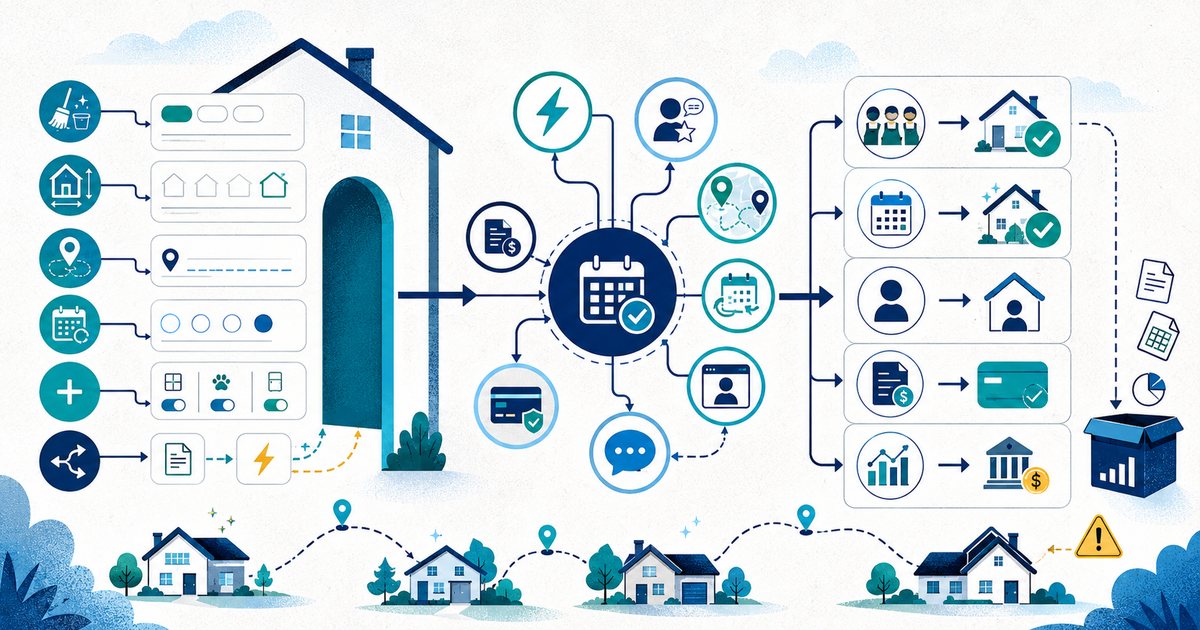
Online booking software for cleaning companies is not just a calendar widget. The real buying decision is whether the system can control the booking form, handle quote requests versus instant booking, support recurring service choices, show realistic cleaner availability, give customers useful self-service, move the booking into the schedule cleanly, collect deposits or payments, send reminders, hand data off to accounting, and let you leave later without losing critical booking data.
If many website requests still need an office-reviewed quote before they become scheduled jobs, compare this article with FieldOpsLab’s estimating and quote software guide for residential cleaners.
Based on public documentation checked on 2026-08-14, with Housecall Pro pricing rechecked on 2026-09-16, BookingKoala is the strongest shortlist when website booking control, customer self-service, and provider-aware scheduling are the bottleneck. Jobber is strongest when online booking needs to sit inside a broader field service management (FSM) workflow with quotes, scheduling, reminders, payments, client communication, and QuickBooks Online (QBO). Housecall Pro stands out when online booking also has to coexist with QuickBooks Desktop (QBD), review management, and broader office workflow; its public 5-user Essentials and 8-user MAX references are useful planning anchors, while 11+ remains sales-led. ZenMaid is the strongest cleaning-specific recurring-workflow option. Workiz is most plausible when booking must connect tightly to phone, SMS, client portal, and AI-assisted intake.
There is no universal winner because these products count people differently, automate different parts of the booking journey, and expose different pricing and exit risks. Public evidence suggests the safest shortlist is usually one broad FSM option plus one specialist option that matches the real constraint in your business.
Quick verdict
| Product | FieldOpsLab view | Main caution |
|---|---|---|
| BookingKoala | Strongest shortlist when website booking control, self-service, and booking-first workflow are the bottleneck. | Provider math, Twilio-based SMS setup, storage tiers, and deletion or downgrade risk need careful review. |
| Jobber | Strongest shortlist when booking must sit inside a broader quoting, scheduling, reminders, payments, and Client Hub workflow. | Named-user pricing can rise quickly once every cleaner and office user needs access. |
| Housecall Pro | Strongest shortlist when online booking needs to coexist with QuickBooks Desktop, reviews, and broader office workflow. | The jump from the 5-user Essentials tier to MAX can materially change cost. |
| ZenMaid | Strongest shortlist when recurring maid-service workflow matters more than broad FSM depth. | Current QuickBooks language, personalized team pricing, and export scope still need written confirmation. |
| Workiz | Strongest shortlist when communications, client portal, phone/SMS, AI intake, and booking need to work together. | Public pricing remains incomplete for real scenario math, and communications add-ons can materially change cost. |
| Manual baseline | Acceptable only as a temporary intake layer for very early-stage operators. | It breaks down once recurring schedules, reminders, saved cards, and reschedules become normal. |
Takeaway: Choose based on operating model, not on whichever homepage says “online booking” the loudest.
In this article
- Key facts
- Best for
- Avoid if
- Buyer scenario
- Why online booking for cleaning is different from generic appointment booking
- What online booking software must handle
- Shortlist methodology
- Comparison table
- Scenario: 2 field workers + 1 office user
- Scenario: 5 field workers + 1 office user
- Scenario: 15 field workers + 2 office users
- BookingKoala online booking notes
- Jobber online booking notes
- Housecall Pro online booking notes
- ZenMaid online booking notes
- Workiz online booking notes
- Manual / website-form baseline
- Pricing and hidden costs
- Online booking demo questions buyers should ask
- Export, migration, cancellation, and booking-data risk
- What public evidence cannot verify
- Buyer verification checklist
- Final recommendation
- Methodology
- Sources
Key facts
| Item | Research-based finding |
|---|---|
| Primary buyer | US residential cleaning company with 2–20 field workers and 1–2 office users that wants customers to request or book cleaning jobs online without creating pricing, scheduling, payment, or migration problems. |
| Core buying problem | The decision is really about booking-form control, quote versus instant-book logic, recurring service setup, customer self-service, availability rules, payments, reminders, accounting handoff, and exit risk. |
| Strongest booking-first shortlist | BookingKoala has the strongest public emphasis on customizable booking forms, customer dashboards, provider scheduling, and booking-first operations. |
| Strongest broad FSM shortlist | Jobber is the strongest broad shortlist when booking is only one part of a wider quotes, scheduling, reminders, payments, and client-portal workflow. |
| Strongest QuickBooks Desktop shortlist | Housecall Pro stands out because its Essentials plan publicly includes QBO and QBD. |
| Strongest recurring-cleaning specialist | ZenMaid remains the most plausible cleaning-specific shortlist when recurring maid-service workflow matters more than broad trade-service depth. |
| Strongest communications-forward shortlist | Workiz stands out when booking has to connect to phone, text, AI, and a branded client portal. |
| Main pricing risk | Visible subscription price is rarely the final story. User math, provider math, SMS, phone, AI, card processing, annual terms, and add-ons matter more than the cheapest visible entry price. |
| Main migration risk | Booking data is harder to migrate than a simple customer list because service questions, recurring rules, upcoming appointments, notes, deposits, reminders, and customer self-service settings do not always export cleanly. |
| Manual baseline | Website forms, Google Forms, Calendly-style pages, Google Calendar, and spreadsheets can collect demand, but they are not durable booking operations software for a growing cleaning company. |
Takeaway: For residential cleaning, online booking is a workflow decision first and a website feature second.
Best for
- US residential cleaning companies with 2–20 field workers and 1–2 office users.
- Teams that run recurring weekly, biweekly, monthly, and custom service schedules plus one-time deep cleans and move-out cleans.
- Owners who need to compare quote-request workflows, instant booking, customer self-service, reminders, payments, and accounting handoff in one place.
- Businesses replacing website contact forms, phone-and-text intake, Google Calendar, spreadsheets, and disconnected payment tools.
Avoid if
- You want a generic appointment-scheduling listicle instead of a cleaning-specific buying guide.
- You want a controlled-account or demo-validated review. This article is research_based.
- You need a guaranteed monthly total before talking to vendors about seats, providers, SMS, phone, AI, taxes, payment fees, or annual terms.
- Your business is primarily enterprise janitorial, franchise multi-branch commercial operations, or outside the scope of local residential cleaning teams.
Buyer scenario
The target buyer is a US residential cleaning business with 2–20 field workers and 1–2 office users. The company may still be using a website contact form, phone calls, texts, Google Calendar, spreadsheets, manual quotes, and separate payment links. It may also be using software that handles scheduling but does not handle online booking cleanly.
The booking mix usually includes recurring home cleans, one-time deep cleans, move-out cleans, and occasional quote-only requests. That means the software has to support both standard services that can be booked instantly and more complex jobs that still need office review.
| Scenario | Field workers | Office users | Why it matters |
|---|---|---|---|
| Small local team | 2 | 1 | Tests whether a simple booking-first tool beats a broader FSM platform on cost and usability. |
| Growing operator | 5 | 1 | Tests the first real seat or provider breakpoint, plus how recurring bookings and reminders scale. |
| Larger local operation | 15 | 2 | Tests provider math, office permissions, customer self-service depth, and migration or cancellation risk. |
Takeaway: Count who truly needs a login, who only needs assignment visibility, and who only needs message delivery before you compare prices.
Why online booking for cleaning is different from generic appointment booking
Residential cleaning is harder than generic appointment booking because the customer is not always booking a fixed, one-room, one-person slot. Many cleaning businesses need the booking flow to ask about home size, bathrooms, extras, frequency, pets, supplies, entry instructions, and location. They also need to decide whether the booking should be quoted first or booked instantly.
Cleaning companies also face recurring-service complexity much earlier than many other local services. A booking tool that works for one haircut or one consultation can fail when the same customer wants biweekly service, occasional skips, a different cleaner, and a saved card on file for future visits.
That is why the most useful public product evidence is not just “has online booking.” It is whether the vendor publicly documents service selection, calendar rules, recurring logic, team assignment, reminders, self-service, deposits or payments, and accounting handoff.
What online booking software must handle
For US residential cleaning, the shortlist should be built around the following requirements:
- Quote or request flow versus instant booking: some services can be standardized, while others still need office approval.
- Service categories and pricing questions: one-time, recurring, deep clean, move-out, add-ons, and custom pricing inputs.
- Service areas and ZIP-code logic: the form has to stop unprofitable or out-of-area bookings early.
- Availability rules: booking windows, minimum notice, drive-time limits, team calendars, and hold or approval rules.
- Recurring options: weekly, biweekly, monthly, and custom repeat logic without forcing staff back into manual entry.
- Customer account functions: view appointments, approve estimates, pay, reschedule, cancel, or request changes.
- Payments: deposits, full prepayment, card on file, invoicing, refunds, and failed-payment handling.
- Reminders and confirmations: email, SMS, on-my-way messages, and internal notifications.
- Booking-to-schedule handoff: the job must land in the calendar with the right service details, assignment rules, and internal notes.
- Tracking and analytics: where leads came from, which form performed best, and which channels actually generated booked work.
- Export and migration: customer data, future bookings, recurring rules, notes, and service responses should not be trapped inside a tool.
Shortlist methodology
FieldOpsLab evaluated the shortlist using public evidence only. The method was to compare each product on the criteria that matter most for cleaning-company online booking rather than on generic appointment-scheduling features.
- Booking-form control: can the business shape the form, pricing questions, service areas, and website embedding?
- Quote-request versus instant booking: can the business choose a request-first model, an instant-book model, or both?
- Recurring booking support: is recurring service treated as a first-class workflow or as an afterthought?
- Customer self-service: what can customers do after the first booking?
- Provider or cleaner availability: does public documentation show assignment and availability logic?
- Payments and deposits: what is publicly documented for prepayment, saved cards, deposits, or online payment?
- Accounting fit: especially QBO and QBD where public documentation is clear enough to trust.
- Pricing transparency: can a buyer model a scenario without a sales call, or is the product clearly quote-sensitive?
- Exit risk: what do public docs suggest about exports, downgrades, cancellation, and data deletion?
Because this article is focused on online booking, a product can be a strong shortlist here even if it would not be the strongest fit for a broader “all cleaning software” guide.
Comparison table
| Product | Operating model | Booking forms | Quote/request fit | Instant-book fit | Recurring booking fit | Customer self-service | Cleaner availability and assignment | Payments and deposits | Accounting fit | Pricing risk | Best-fit scenario |
|---|---|---|---|---|---|---|---|---|---|---|---|
| BookingKoala | Booking-first platform with website, forms, customer account, provider account, and smart scheduling. | Very strong public evidence for customizable one-step, two-step, and Premium multi-step forms, website embedding, ZIP logic, and tracking-code support. | Good for leads, prospects, and quotes, but stronger when the goal is to move toward structured online booking. | Very strong for standardized services with real-time availability rules. | Strong public emphasis on recurring appointments and customer dashboard controls. | Strong. Public help docs show customer reschedule, cancel, postpone, resume, and add-tip actions. | Strong. Public docs show real-time availability, provider or team rules, and provider mobile workflow. | Strong for online charges and processor choice. Pre-charges are documented; cancellation-fee handling should be verified in a demo. | Public evidence for direct accounting handoff is weaker than Jobber or Housecall Pro. Verify before buying. | Provider count, storage, Twilio, campaigns, and downgrade rules can all move cost. | Most plausible when website booking and self-service are the operational bottleneck. |
| Jobber | Broad FSM with online booking, Client Hub, quotes, scheduling, reminders, payments, and recurring jobs. | Good. Public docs show bookable services, durations, team assignment, and scheduling preferences. | Strong hybrid fit because Client Hub and requests support approval-heavy workflows. | Strong for standardized bookable services with automated assignment. | Strong. Public help docs show recurring visits and individual-visit changes. | Strong. Client Hub covers requesting work, approving quotes, viewing appointments, and paying online. | Strong for automatic team assignment and schedule controls. | Strong for deposits and online payments in Client Hub. Card-on-file details should be confirmed for your exact workflow. | Strong public QBO fit. | Named-user pricing is easier to model than some rivals, but it still climbs as the team grows. | Most plausible when booking is only one part of a broader operating system. |
| Housecall Pro | Broad home-service platform with online booking, reviews, customer communication, payments, and stronger office tooling. | Good. Public docs show website or Google booking, dynamic pricing, and customer portal access. | Strong hybrid fit because quotes and proposals live alongside online booking. | Strong for standardized services that can be booked and paid online. | Strong. Public help docs clearly explain editing one recurring job versus the future series. | Good. Public docs show customer portal functions for viewing, rescheduling, or canceling when enabled. | Good, especially once you need a broader dispatch workflow. | Strong for online booking with payment, saved cards on file, and ACH support. | Very strong public fit for QBO and QBD. | Seat thresholds matter a lot, especially once you move beyond 5 users. | Most plausible when you want broad home-service depth and QBD support. |
| ZenMaid | Cleaning-specific scheduler and booking tool built around maid-service workflow. | Good public evidence for website booking forms, but feature depth depends on plan. | Reasonable for cleaning-specific intake, especially when staff still wants office review. | Good for standardized recurring maid-service offers. | Strong cleaning-specific fit for recurring schedules and cleaner workflow. | Public evidence is weaker for a rich customer portal than for BookingKoala, Jobber, or Workiz. | Strong on cleaner-facing workflow, assignment visibility, checklists, and appointment details. | Strong for invoicing and saved cards through Stripe or Square, but ZenMaid says deposits and pre-authorizations are not supported at this time. | Current public pricing says QuickBooks integration is coming soon on Pro. Do not treat accounting handoff as settled. | Visible entry price is low, but personalized team pricing and SMS charges make the real number less transparent. | Most plausible when recurring maid-service workflow matters more than broad FSM breadth. |
| Workiz | Communications-forward FSM with online booking, client portal, phone system, AI answering, and integrated payments. | Good public evidence for booking widgets, Google booking, rules, approval options, and deposit settings. | Strong hybrid fit because bookings can require approval before confirmation. | Good for instant booking when rules and service areas are standardized. | Public pricing shows recurring jobs as a supported feature. | Strong. Client Portal handles estimates, invoices, upcoming appointments, and online payments. | Good, especially where booking has to connect to dispatch and communication workflows. | Strong for online payments and estimate deposits; communications and payment add-ons can still expand cost. | Strong public evidence for QBO. No current official public evidence found here for QBD. | High pricing uncertainty because base subscription is request-pricing and communications are sold separately. | Most plausible when booking has to work with phone, text, AI, and lead tracking. |
| Manual baseline | Website forms, Google Forms, Calendly-style pages, Google Calendar, spreadsheets, and separate QuickBooks payment links. | Weak beyond simple intake. | Good for pure request-only intake. | Weak for true instant booking with pricing logic and team-aware availability. | Weak once recurring logic matters. | Very limited. | Manual. | Usually disconnected. | Can coexist with accounting tools but does not solve handoff problems. | Cheap at first, expensive in staff time later. | Temporary bridge only. |
Takeaway: BookingKoala is the strongest booking-first option, but Jobber and Housecall Pro become more compelling as soon as online booking is only one part of a wider office workflow.
Scenario: 2 field workers + 1 office user
This scenario tests the smallest team that still feels real booking pressure. Three people may not sound large, but it is enough to expose seat math, recurring-service expectations, and the need for at least basic customer self-service.
| Product | Likely public pricing path | Main workflow strength | Main booking risk | Main cost risk | Buyer action |
|---|---|---|---|---|---|
| BookingKoala | Starter starts at $27/month for up to 5 providers. Growing starts at $57/month if SMS and more automation matter. | Very strong fit if the website is the main sales channel and you want a real customer dashboard early. | Can feel too booking-first if you mainly need quotes, office controls, and accounting depth. | Twilio, storage, and optional growth paths can add cost later. | Shortlist first if self-service and online booking are the main pain point. |
| Jobber | The current public model places 3 users in the Connect 5-user band. Core remains a one-user starting path. | Strong hybrid fit when quotes, reminders, payments, and client communication matter as much as booking. | Less form-centric than BookingKoala for website conversion experiments. | Team-size bands can create a pricing jump when every cleaner needs a login. | Shortlist if you want one broad operating system instead of a booking-first tool. |
| Housecall Pro | Essentials includes 5 users and covers this 3-login scenario; confirm billing cadence and any add-ons. | Strong if you want online booking, reviews, payments, and a future path toward QBD. | May be more office-system than a tiny team really needs if booking-form control is the only problem. | The jump from 1 user to Essentials is meaningful for a small team. | Shortlist if broader office workflow matters more than deep booking-form control. |
| ZenMaid | Public list prices start at $19, $39, and $49 per month, but the calculator changes with cleaner and office-manager counts. For online booking, Pro is the first meaningful public tier. | Strong if the business mainly sells recurring maid service and wants cleaner-friendly workflow. | Customer self-service depth is less clearly documented than BookingKoala or Jobber. | Personalized team pricing and SMS charges reduce certainty. | Shortlist if cleaning-specific recurring workflow matters more than broad FSM depth. |
| Workiz | Pricing is request-based for Standard, Pro, and Ultimate. The current public page does not state included users or extra-member rates, so total cost is not public enough to model safely. | Interesting if calls, texts, and lead capture already dominate your intake. | Can be heavier than needed for a three-person residential cleaning operation. | Base price, phone, and AI costs are not transparent enough for small-team budgeting. | Shortlist only if communications are already the main constraint. |
| Manual baseline | Low visible software spend, but high office labor. | Fine for temporary request intake and simple quote follow-up. | No true customer self-service, weak recurring logic, and manual reminder risk. | Time cost becomes the hidden cost. | Use only while preparing a structured software switch. |
Takeaway: For 2+1 teams, the usual fork in the road is BookingKoala if online booking itself is the bottleneck, or Jobber if booking is only one piece of the system you need.
Scenario: 5 field workers + 1 office user
This is the first team size where online booking usually stops being a “nice website feature” and starts affecting dispatch, reminder volume, recurring setup, and cost structure. It is also the point where user and provider math become much harder to ignore.
| Product | Likely public pricing path | Main workflow strength | Main booking risk | Main cost risk | Buyer action |
|---|---|---|---|---|---|
| BookingKoala | Starter can technically fit 5 providers. Growing at $57/month is usually more realistic if you want SMS notifications and more operational headroom. | Still one of the strongest public fits for website booking, service-area logic, and customer self-service. | If you need deeper accounting workflow or more traditional quote management, broad FSM products may fit better. | Provider count stays manageable here, but storage, contact growth, and Twilio can change the real cost. | Shortlist when the main business question is still “how do we let customers book correctly online?” |
| Jobber | The current public model places 6 users in the Connect 10-user band; Grow is relevant only if its added features are required. | Strongest broad shortlist when you want booking plus recurring jobs, reminders, Client Hub, and QBO. | Website booking flow is more standardized than BookingKoala’s form-first model. | Per-user growth continues to matter. | Shortlist if you want one broad operating system and can live with a more standardized booking flow. |
| Housecall Pro | MAX includes 8 users and covers this 6-login scenario without additional-user charges. Essentials includes only 5; confirm billing cadence, add-ons, taxes, and final terms. | Strong when booking needs to sit beside reviews, payments, customer communication, and QBD. | The product may be broader than needed if the only issue is web booking. | The Essentials-to-MAX jump is material, and add-ons can expand spend. | Shortlist if office workflow depth and accounting fit matter enough to justify the seat jump. |
| ZenMaid | Pro or Pro Max is the more plausible online-booking path, but total subscription should be confirmed in writing because team pricing is personalized. | Strong on recurring maid-service workflow, cleaner notes, checklists, and booking-form fit. | Public evidence is still lighter on customer self-service depth and accounting maturity. | Team-count pricing, SMS, and feature gates can change the real number. | Shortlist if recurring maid service is the core business model and broad FSM depth is not the priority. |
| Workiz | Still hard to model because subscription pricing is request-based. The current public page does not state included users or extra-member fees for Standard and Pro. | Stronger than before if this team already relies on phone, text, and heavy lead-response speed. | May feel communications-heavy if your actual bottleneck is form pricing logic rather than call handling. | Base subscription, phone system, and AI answering all increase uncertainty. | Shortlist only if communications and lead-intake speed already shape the business. |
| Manual baseline | Still cheap on paper. | Works only as a short bridge while cleaning up data. | Recurring reschedules, reminders, and deposits become hard to manage manually at this size. | Office labor and missed handoffs usually cost more than the subscription you tried to avoid. | Do not treat manual tools as a durable operating system here. |
Takeaway: For 5+1 teams, the strongest shortlist is usually BookingKoala or ZenMaid for a cleaning-specific booking model, or Jobber or Housecall Pro for a broader office workflow.
Scenario: 15 field workers + 2 office users
This is the scenario where small-team shortcuts break. Larger local cleaning companies need stronger office control, cleaner assignment logic, recurring-booking stability, and a much clearer understanding of what happens to pricing and data if the system stops fitting later.
| Product | Likely public pricing path | Main workflow strength | Main booking risk | Main cost risk | Buyer action |
|---|---|---|---|---|---|
| BookingKoala | Growing starts at $57/month for 15 providers, but Premium at $197/month becomes more plausible if you want multi-step forms, campaigns, or more headroom. | Still very strong when online booking, customer dashboards, and provider-aware scheduling are central. | Can feel too booking-first if accounting, office permissions, and broader service operations are now the main challenge. | A 15-provider cap leaves no room for growth, and downgrade rules can force deletions later. | Shortlist if the website booking engine is still the company’s biggest leverage point. |
| Jobber | Jobber directs 16+ users to sales, so the 17-user scenario requires a written quote. Exact tier also depends on feature needs. | Very strong when you want named-user math, recurring jobs, reminders, Client Hub, and clear QBO handoff. | Booking-form control still trails BookingKoala. | Named-user pricing becomes substantial once 17 people need access. | Shortlist first if you want the broadest publicly modelable system for this team size. |
| Housecall Pro | The current public page does not expose a dependable 17-user total in its extracted plan copy. Request a tailored quote rather than extending a base plan with historical per-user math. | Strong when online booking must live with reviews, customer communication, payments, and QBD. | May be broader and more expensive than a cleaning-specific workflow actually needs. | Large-team user math and add-ons can materially raise spend. | Shortlist if office depth, QBD, and review workflow matter enough to justify the price. |
| ZenMaid | Pro Max is the most plausible public path, but the real number remains personalized by cleaner and office-manager count. | Good fit if the company still behaves like a recurring maid-service specialist rather than a broad home-service operator. | Customer self-service breadth and accounting maturity remain less clear in public evidence. | Large-team price certainty is lower than with Jobber or Housecall Pro. | Shortlist if recurring cleaning workflow still outweighs broad-office feature depth. |
| Workiz | Ultimate or custom becomes the realistic path, and public pricing is not transparent enough for a safe final number. | Strong if the company depends heavily on integrated phone, text, portal, and AI-supported intake. | Could be too communications-heavy if your actual problem is cleaner scheduling discipline. | Quote-sensitive pricing and annual-term rules need especially careful review. | Shortlist if communications and booking speed are now central to growth. |
| Manual baseline | Not realistic as a durable system. | Only useful for temporary archives or migration staging. | Too much manual failure risk for recurring service, reminders, and payment follow-up. | The labor cost is no longer defensible. | Replace it. |
Takeaway: For 15+2 teams, Jobber is often the safest broad shortlist, Housecall Pro is the strongest QBD-oriented shortlist, and BookingKoala remains the booking-first specialist when website conversion and self-service still lead the decision.
BookingKoala online booking notes
Best fit for
BookingKoala is the strongest shortlist when the business wants booking-first software rather than a general FSM tool. Public product pages emphasize customizable booking forms, website options, smart scheduling, customer accounts, provider accounts, tracking codes, and recurring appointments.
Where public evidence is strongest
BookingKoala’s features page describes one-step, two-step, and Premium multi-step forms, pricing logic by quantity or parameters, ZIP or location logic, tracking-code support, and recurring appointments. Public help docs also show a rich customer dashboard where customers can reschedule, cancel, postpone, resume, and manage recurring bookings if the business allows those actions.
Main cautions
The strongest caution is commercial math. BookingKoala prices around providers and storage, not simple named users. Its pricing page says each team member counts as a provider, which matters a lot once you dispatch in pairs or have float staff. Public docs also show that downgrades can require deleting providers, industries, locations, and contacts, and the cancellation article says closing the account deletes stored data that cannot be retrieved.
Payments, reminders, and accounting cautions
Public help docs show support for Stripe, Square, PayPal via Braintree, and Authorize.net, plus public documentation for automatic charges, pre-charges, and provider payouts. SMS requires a separate Twilio setup. Public evidence for direct accounting handoff is weaker than for Jobber or Housecall Pro, so buyers should verify exactly how any accounting sync or workaround is supposed to function before purchase.
What to verify first
- Whether your booking model really needs one-step, two-step, or multi-step forms.
- How providers, teams, deactivated providers, and office staff affect billing in your exact setup.
- Whether your customers can reschedule, skip, postpone, or cancel recurring bookings exactly the way you want.
- How Twilio costs will behave at your reminder volume.
- What data you can export before downgrade or cancellation.
Jobber online booking notes
Best fit for
Jobber is the strongest shortlist when online booking is only one part of the system you need. Public pricing and feature pages show online booking, Client Hub, reminders, automatic payments, recurring visits, and QBO support in the same stack.
Where public evidence is strongest
Jobber’s online booking page documents bookable services, team-assignment rules, schedule controls, service-area and drive-time efficiency settings, and automated confirmations. Client Hub gives customers a portal to request work, approve quotes, view appointments, and pay invoices or deposits. Public help docs also show recurring jobs and visit-level changes, including how one recurring visit can be edited without changing the whole series.
Main cautions
Jobber’s main caution is not lack of features. It is user math. Public pricing defines a user as anyone who accesses the schedule in the office or field, and adds users at a stated monthly amount. That is easier to model than provider-based pricing, but it can still become expensive if every cleaner needs a full login.
Payments, reminders, and accounting cautions
Public pricing explicitly lists automated client reminders, automatic payment collection, and QBO sync. That makes Jobber one of the clearest accounting and reminder stories in this shortlist. The caution is that buyers still need written confirmation on plan gating, add-ons, application programming interface (API) access, and the exact seat path they will need over the next year.
What to verify first
- Whether online booking can handle your service-level pricing logic without too much compromise.
- Which users truly need full logins.
- Whether your team needs a request-first workflow, instant booking, or both.
- How far Client Hub covers the customer self-service experience you want.
- Exactly which exports you can access before changing plans or leaving.
Housecall Pro online booking notes
Best fit for
Housecall Pro is the strongest shortlist when online booking has to coexist with broader office workflow, review management, online payments, and especially QBD.
Where public evidence is strongest
Housecall Pro’s pricing page publicly documents online booking, reviews, customer communication, and the QBO/QBD inclusion on Essentials. Its online booking page also describes website and Google booking, dynamic pricing, and customer portal actions for viewing, rescheduling, or canceling when enabled. Public help documentation on recurring jobs is also clearer than many generic booking tools.
Main cautions
Seat entitlement is the biggest issue. Housecall Pro now publishes Basic with 1 user, Essentials with 5 users, and MAX with 8 users; a growing cleaning company should use those as planning references, then request written pricing for 11+ users, add-ons, additional-user charges, and its exact login count before purchase.
Payments, reminders, and accounting cautions
Housecall Pro’s payments page publicly documents card-on-file support, online payments, ACH support, and payment links. That is a strong public payments story. The caution is that payment features do not answer every operational question. Buyers still need to verify deposit logic, refund handling, cancellation-fee workflow, and how accounting cleanup works after import.
What to verify first
- Whether your 2+1, 5+1, or 15+2 team truly needs full logins for all cleaners.
- How the customer portal behaves for reschedules and cancellations in your policy setup.
- What the real configured quote looks like after included users, any additional-user charges, and add-ons.
- How much of your current data can be imported without rework.
- Whether QBD is a real requirement or only a nice-to-have.
ZenMaid online booking notes
Best fit for
ZenMaid is the strongest cleaning-specific shortlist when recurring maid-service workflow matters more than broad FSM depth. It is especially plausible for businesses that sell recurring residential cleaning as their core offer and want software that feels cleaner-friendly rather than trade-generic.
Where public evidence is strongest
ZenMaid’s booking page emphasizes website booking forms for quotes and scheduling. Its scheduling page emphasizes recurring scheduling, map and dispatch views, appointment reminders, and cleaner mobile access. The mobile app page also highlights cleaner notes, checklists, “on my way” messaging, and job-complete updates.
Main cautions
The public list price is attractive, but it is not the whole story. ZenMaid’s pricing page asks for cleaner and office-manager counts, lists SMS as excluded from the visible monthly price, and ties some booking features to higher tiers. For online booking specifically, Starter is usually too limited because it caps appointments and does not position booking forms as strongly as Pro or Pro Max.
Payments, reminders, and accounting cautions
ZenMaid publicly supports Stripe and Square for online payments and card storage, and its invoicing pages describe invoices tied directly to appointments. However, its credit-card processing page also says deposits and pre-authorizations are not currently supported. Just as important, the pricing page currently labels QuickBooks integration as “coming soon” on Pro. Buyers should not assume accounting handoff is settled without fresh written confirmation.
What to verify first
- Your real price after entering cleaner and office-manager counts.
- Whether the customer booking flow fits your exact residential-cleaning pricing logic.
- Whether your business can live without formal deposit support.
- What “export of your data” includes in practice and on which tier.
- Whether the current QuickBooks language has changed since the public page was checked.
Workiz online booking notes
Best fit for
Workiz is the strongest shortlist when communications are central to the booking operation. Public materials combine online booking, client portal, integrated phone, two-way messaging, AI answering, and ad-source tracking more tightly than most competitors in this guide.
Where public evidence is strongest
Workiz’s online booking page documents Reserve with Google, website widgets, booking rules, approval-before-confirmation options, deposits, and source tracking. The Client Portal page documents approving estimates, paying invoices, reviewing job history, seeing upcoming appointments, and accessing documents. The communications page adds the AI answering and integrated phone angle that makes Workiz distinctive.
Main cautions
The strongest caution is commercial transparency. Public pricing lists plan names and Request pricing controls, but it does not publish included-user allowances, extra-member rates, or a complete final monthly number for a realistic cleaning-team configuration. Communication add-ons are sold separately. That makes Workiz harder to model responsibly than Jobber, Housecall Pro, BookingKoala, or the visible ZenMaid entry tiers.
Payments, reminders, and accounting cautions
Workiz publicly documents online payments, estimate deposits, client-portal payments, and QBO sync. It also sells communications modules separately, and its terms page contains auto-renewal language for successive 12-month terms unless proper notice is given. Buyers should treat phone, AI, and term structure as part of the pricing decision, not as side notes.
What to verify first
- Your exact subscription for 2+1, 5+1, and 15+2.
- Which communication tools are included and which require separate purchase.
- Whether your customers can self-serve the exact booking changes you want.
- Whether you need QBD, because this review did not find current official public evidence for it.
- What notice period and export process apply if you later decide to leave.
Manual / website-form baseline
Many cleaning businesses start with a website contact form, Google Form, Calendly-style page, Google Calendar, spreadsheet intake, and a separate invoicing or payment layer. That can work as a temporary demand-capture system, especially when the business is still making pricing decisions manually.
The problem is that these tools do not form one booking system. They collect demand, but they do not reliably handle recurring choices, cleaner availability, self-service, saved cards, automated reminders, reschedules, or clean booking-to-schedule handoff. The office ends up doing those steps manually.
Use this baseline only when one of the following is true:
- You are still validating your service menu and do not yet want instant booking.
- You are cleaning up data before moving into structured software.
- You need a temporary backup intake path during migration.
Stop relying on manual tools once recurring bookings, skipped visits, reminder volume, or after-hours booking demand become normal.
Pricing and hidden costs
Visible plan price is only the first layer of cost. Cleaning-company online booking almost always triggers at least one second layer: users, providers, SMS, Twilio, phone, AI, card processing, deposits, onboarding, imports, or annual terms.
| Product | Public subscription signal | Main hidden-cost pressure | What to verify |
|---|---|---|---|
| BookingKoala | Starter $27, Growing $57, Premium $197, with larger Premium tiers above that. | Providers, storage, Twilio, campaigns, and Premium-only booking features. | Provider count, office-user treatment, SMS volume, and whether Premium is required for your form design. |
| Jobber | Public named-user pricing with extra-user charges. | User count, feature tier upgrades, payment fees, and optional communication tools. | Exact plan for your team, which users really need access, and whether Connect, Grow, or Plus is the right tier. |
| Housecall Pro | Basic includes 1 user, Essentials includes 5, and MAX includes 8. MAX lists $35/month per additional user above 8; confirm final billing and add-on terms. | User thresholds, add-ons, payment costs, and possible migration support needs. | Real MAX cost, extra-user count, and whether you need QBD or can stay on a cheaper path. |
| ZenMaid | Visible list prices start low, but the pricing calculator changes with cleaner and office-manager counts. | Personalized team pricing, SMS, plan gates, and current accounting status. | Your real team quote, what tier unlocks the booking flow you need, and whether export access is tier-limited. |
| Workiz | Standard, Pro, and Ultimate use Request pricing. Included-user allowances and extra-member charges are not stated on the current public pricing page; obtain them in writing. | Phone system, AI answering, messaging, annual terms, and quote-sensitive packaging. | Full subscription, communications package, payment fees, and term commitment. |
| Manual baseline | Very low visible software spend. | Office labor, missed reminders, bad handoffs, and delayed payments. | How much admin time you are actually burning to avoid software spend. |
Takeaway: The cheapest visible plan is rarely the lowest-cost booking workflow once reminders, recurring services, and office labor are included.
Online booking demo questions buyers should ask
- Show the exact booking form a residential cleaning customer would use on mobile and desktop.
- Show how the system handles quote requests versus instant booking for different service types.
- Show how service areas, ZIP codes, minimum notice, and booking windows are enforced.
- Show how recurring weekly, biweekly, and monthly bookings are offered during checkout.
- Show how a customer reschedules, cancels, postpones, or skips one recurring visit.
- Show what happens after a booking is submitted: who gets notified, what lands on the calendar, and how assignment happens.
- Show how reminders work by email and SMS, including any extra cost.
- Show how deposits, saved cards, failed payments, refunds, and no-show or late-cancel policies are handled.
- Show how the system hands data to QBO or QBD if you claim accounting integration.
- Show what customer, booking, and recurring data can be exported.
- Show what happens on downgrade or cancellation and how long data remains accessible.
- Give the quote in writing for 2+1, 5+1, and 15+2 team scenarios.
Export, migration, cancellation, and booking-data risk
Booking data is harder to move than a simple contact list. A true migration may need customer details, service addresses, notes, line items, future appointments, recurring frequency rules, payment settings, reminders, staff assignments, tags, and attachments. Public evidence suggests each vendor is stronger in some parts than others.
| Product | Public export or migration signal | Main risk |
|---|---|---|
| Jobber | Jobber publishes client export help and a recurring-jobs report export to CSV. | Public evidence does not prove export completeness for every booking object or post-cancellation access. |
| Housecall Pro | Housecall Pro publishes import and export help for customers and jobs, plus import notes for MAX. | Additional import fees may apply for some complex conversions, and public docs do not prove full attachment or workflow portability. |
| ZenMaid | Public pricing says Pro Max includes “Export of your data,” and the company advertises free contact and calendar transfer. | Public evidence does not fully define export depth, and terms warn downgrades may cause loss of content, features, or capacity. |
| BookingKoala | Public help docs reference customer, provider, and lead data exports before cancellation. | Cancellation deletes the entire account and BookingKoala says deleted data cannot be retrieved. Downgrades may require deleting providers or other records. |
| Workiz | In this review, public pricing and terms provide more commercial detail than export detail. | Export scope was not clear enough from current public evidence. The terms page also includes auto-renewal and non-refund language that buyers should read carefully. |
| Manual baseline | CSV and spreadsheet exports are simple. | But the workflow history is fragmented across email, texts, calendars, forms, and payment tools. |
Takeaway: Ask for sample exports before signing and again before canceling. Do not assume that customer lists, future bookings, and recurring rules will leave together in a clean format.
What public evidence cannot verify
- Live booking conversion lift for any vendor.
- Exact customer behavior inside self-service portals under every edge case.
- How often customers actually reschedule or cancel through self-service instead of calling.
- How each tool behaves with skipped recurring cleanings, lockouts, or unusual frequency rules.
- How well cleaner assignment really works in a live residential-cleaning operation.
- How much staff training and change management each tool needs.
- The final quote after add-ons, payment fees, taxes, phone, AI, SMS, onboarding, and contract terms.
- The true completeness of exports and the smoothness of migration.
- Support quality, cancellation experience, or post-cancellation data access in practice.
Buyer verification checklist
- Get the exact quote for 2+1, 5+1, and 15+2.
- Confirm who needs full logins, who only needs assignment access, and who only needs notifications.
- Confirm whether pricing is based on users, providers, or another metric.
- Confirm whether the booking flow is request-first, instant-book, or hybrid.
- Confirm recurring-service setup, skipped-visit behavior, and one-off reschedules.
- Confirm what customers can do themselves after booking.
- Confirm how providers or cleaners are assigned after a booking arrives.
- Confirm reminder defaults, SMS costs, and any Twilio or phone requirements.
- Confirm payment processing fees, deposit workflow, saved-card behavior, refunds, and cancellation-fee options.
- Confirm QBO or QBD handoff in writing if accounting is important.
- Confirm website embedding, Google booking options, and source tracking.
- Confirm what customer, booking, recurring, and payment-related data can be exported.
- Confirm migration help, onboarding scope, and any extra import fees.
- Confirm contract length, renewal rules, downgrade restrictions, and cancellation process.
Before choosing BookingKoala for online booking: verify form setup, service-area rules, provider availability, deposits/payments, recurring booking behavior, customer dashboard limits, SMS/Twilio setup, exports, and cancellation terms.
If BookingKoala matches your booking-first workflow, request a BookingKoala demo.
Final recommendation
If the main bottleneck is the booking experience itself
Shortlist BookingKoala first. Public evidence is strongest when the business needs stronger booking forms, website embedding, service-area logic, self-service, and provider-aware booking. Add ZenMaid if you run a recurring maid-service model and want a more cleaning-specific operating system.
If booking is only one part of the workflow you need to fix
Shortlist Jobber first. It is the most balanced public fit when the real requirement is booking plus quotes, reminders, recurring visits, payments, and a customer portal. Add Housecall Pro if QBD, reviews, and stronger home-service office workflow matter enough to justify the seat jump.
If communications drive the business
Shortlist Workiz only if your company already depends on speed to lead, phone handling, texting, and portal-based communication. It can be a strong fit, but public pricing is too incomplete to treat lightly.
If you are still on forms, calendars, and spreadsheets
Use them only as a short transition layer. For any cleaning business that depends on recurring work, reminders, saved payments, and post-booking changes, manual tools are a temporary bridge, not a durable operating system.
For a wider buying framework beyond online booking, see FieldOpsLab’s cleaning business software guide. If recurring schedules, skipped visits, or team routing are the larger bottleneck, use the recurring cleaning scheduling software guide. If your current shortlist is specifically BookingKoala versus ZenMaid, use the operating-model comparison. If migration risk is already keeping you from switching, review the migration checklist.
Methodology
This article was built from public vendor documentation checked on 2026-08-14 and from FieldOpsLab’s internal comparison work across the residential-cleaning software cluster. The public sources reviewed included current pricing pages, product pages, help-center documentation, import and export articles, payment pages, and terms pages for BookingKoala, Jobber, Housecall Pro, ZenMaid, and Workiz.
FieldOpsLab did not use controlled product accounts, vendor-guided demo sessions, operator interviews, or live workflow verification for this article. That is why the guidance stays focused on what public evidence supports, what scenario math is safe to model, and what buyers still need to verify directly before purchase.
Sources
- BookingKoala: Pricing; Features; Customer dashboard explained; Provider app overview; Payment processors overview; Set up Twilio; Upgrade or downgrade your subscription; Close or cancel your account.
- Jobber: Pricing; Online booking; Client Hub; Visits; Export client information; Recurring jobs report.
- Housecall Pro: Pricing; Online booking; Payments; Manage recurring jobs; Import and export jobs and customers.
- ZenMaid: Pricing; Cleaning booking software; Cleaning service scheduling software; Cleaning business app; Invoicing; Credit card processing; Terms of service.
- Workiz: Pricing and plans; Online booking; Client portal; Phone system and communications; Online payments; Terms and conditions.